January 17, 2013

2013

At first, we were second guessing ourselves.

"Play it again, but just the ending," I whispered.  

With stiff, cold fingers, Andy played the call again off his Ipod.  Reverberating off the cold oak ravine walls, the eerie wail belted out.  We stopped.  We listened.

"There!"  

It was the same whine, but this time closer.  The routine repeated twice, and twice more we got the same response.  

"I really can't think of it being anything else."
Andy nodded in agreement and we moved on.  Shaking of the near sub zero temps we crunched through the ice laden grass alongside the ravine edge, happy with the first bird of 2013 -- a calling Northern Saw-whet Owl.  

Not only was this CBC bird a first for the year, it was a first for the county.  As we stood in silence attempting to solicit a response from the resident pair screech-owls (thankfully they called back), my mind drifted into thoughts of avian resolutions.

Outside of birding, this is proving to be a busy year in my life.  This will most likely be my first year of having my own classroom, leading to weekends spent grading, not lake watching.  I had originally planned on making this my time to tackle a Lake County Big Year, but my schedule is taking me in another direction.

It is impossible, however, for me to start a new year of birding without specific goals in mind.  Being so busy, it has led me to become more creative in my goals and will keep my closer to home.  If you're a birder who keeps lists, I encourage to make goals for the new year that go beyond lifers.  I enjoy being competitive with myself and I find that I end up spending more time in the field studying birds if I have fun challenges for myself.   Also, making them public on a blog keeps me honest in my ventures forward...

1. Local Patch Big Year: I've decided that, if I can't see as many species as possible in Lake County, why not try to set a record for a location?  I've chosen to try and see as many species as possible at Waukegan Beach.  This lakefront site has a previous year high of 164 species set by Eric Walters in 2009.  I believe this location, if birded regularly and scrupulously,  could yield close to 200 species.  The combination of lakefront, dunes, and "park" habitat lend it to be a great migration hot spot.  Breeding species is lacking, but most of the regular breeders can be picked up during migration.  My life list for the park is currently 165.  I have my work cut out for me :)

2. County Ticks to 1,000:  County listing is new territory.  Biring with some of the best in Illinois has given me the bug for county listing.  This is the one goal that will take effort and time.  I'm currently sitting at 749 county ticks.  I know this is inaccurate, as I just didn't take as detailed notes in the past of birds seen.  However, I'd rather start clean and go from here.  I believe I can easily reach 1,000 ticks by birding McHenry and Cook county in the right seasons this year.

3. 350 Year List:  This year list is including the entire ABA region.  I have a few trips I know I'm taking that could boost me to this level.  Without trying for most of the year, I reached 301 in 2012.  It was thrilling to reach that milestone, so I'd love to get farther with a more concerted effort.

I have other minor goals that include state lifers to 315 and adding ten new county lifers, but these would just be added bonus to my 3 goals for the year.  Even writing this, I can feel my mind drifting out into the field.  I'll post my progress here.

What are your goals for the year?


Good Birding,

Sell

June 28, 2012

Westward, Ho!

Colorado.  It might be my favorite state to visit.  As a youngster, my family would make yearly trips in the summer to the Sangre de Cristo Mountains in Southeastern CO.  Some of my most vivid childhood memories involve me gallivanting through the chaparral and open pine woods of the foothills in search of feathered montane specialties.

Once again, I feel that Westward tug in my gut.  My dad and I are making a run out to Colorado for some fly fishing.  I've never fly fished, but always thought it looked inexplicably manly, so I welcome some added chest hair.  However, this is but the guise.  We all really know why I'm going to Colorado......

It's birds, by the way...

Though I'll be fishing in the highlands of Clear Creek County, my eyes are fixed upon the vast expanses of Weld County.  For birders, Weld County can mean only one thing: The Pawnee National Grassland.  It is here that some of the most sought after prairie species can be found with relative ease.  This is a mostly untouched habitat of Colorado for me and many species will be lifers.

This is no small patch of grass, people.  The Pawnee (as it will be called from now on) is a prodigious tract of private and federally owned land.  The federally managed land alone totals 193,060 acres.  I love big skys and endless land, so this my Disney World.  I spent a total of twenty minutes in The Pawnee this past Thanksgiving and had just enough time to snag my lifer Ferruginous Hawk. That quick foray into The Pawnee did nothing but whet my appetite for seeing this place in breeding season glory.
Ferruginous Hawk - Weld Co.
During the breeding season, this windswept landscape harbors such grassland jewels as Mountain Plover, Burrowing Owl, Lark Bunting, McCown's and Chestnut-collared Longspurs.  Oh, and let's not forget about the open country raptors!  Any given county road in The Pawnee can produce Prairie Falcon, Swainson's Hawk, Ferruginous Hawk and, my favorite, the Golden Eagle.  To someone not in tune with the natural world, The Pawnee would look void of life.  However, for the naturalist and birder (naturalist birder?), nothing could be farther from the truth.  The Pawnee is alive!  Praire Dog towns dot the landscape, and are utilized by the Burrowing Owl.  You didn't think they actually made their own burrows, did you?  Pronghorn Antelope, the fastest land animal in the new world, tear through the land with no regard to man-made boundaries.  There are snakes, lizards, foxes, coyotes....you get the point.  It's not dead.  It's not just pastureland.  This place is wild.

This isn't the only wild place I'll be vistiting.  Though The Pawnee is unchartered territory for me, there other species I'd like to spot; some of them are old friends and some are just a shot in the dark.  

I've generated a list of my target species, but first a shameless plug for eBird.  I cannot even begin to write to you how great of a tool eBird is.  I've spent the past few days combing eBird data to find recent sightings of the birds I'm looking for.  The data is accurate and can give me specific locations sometimes not available in the literature!  Not only is eBird useful to find up-to-date and historical sightings, but the effort of individuals uploading their sightings to eBird adds to our collective knowledge of the birds we love.  Keep your lists, become a better birder, add to science...what's not to love?  So, do you eBird?

Westward, Ho! July 1-5 2012

Cinnamon Teal (State/Year) 
Though, this beautiful dabbler is not on the top of my list of must-sees, I certainly plan on searching a few lakes and ponds in the Boulder County area for this species.  

Eared Grebe (State/Year)
Same as the Cinnamon Teal.  I've seen them in New Mexico and Illinois, but never in full breeding plumage.  I've always thought they looked quite dapper.  I'll be checking Lower Church Lake near Broomfield for them.  

Ferruginous Hawk (Year)
I can't get enough of this bird and seeing it briefly last year has left me craving more.  This is a Pawnee speciality and could show up anywhere in that area.  Of course, I'd love to find a dark morph!  

Prairie Falcon (Year)
It's been years since I've seen this bird.  I saw one last at the Garden of the Gods in Colorado Springs, where I saw one on a nest.  Again, this is a Pawnee species that isn't tied down to a specific location.  This is an effort bird.  I'll be especially looking for land with rock faces or other formations where this species can perch before launching after it's prey like a bat out of hell.  

Mountain Plover (Lifer)
A denizen of the sparse grasslands found in The Pawnee.  I'll be checking "Murphy's Pasture" along CR 96 for this plover.  This species will take some work, that's for sure.  I've heard they can associate with prairie dog towns, as well.   It's speculation, but I'd imagine that many are already done breeding, which might make them more dispersed?   I'm thinking that could make the species even harder to find.

Upland Sandpiper (State/Year)
I haven't seen one in years.  School has made it difficult for me to take the time to find this "grass" piper in Illinois.  I have a few spots west of Kearny, Nebraska I'll be checking for Uppies.  In Colorado, there are long stretches of Highway 138 in Sedgwick County that support them.

Flammulated Owl (Lifer)
 A total shot in the dark. I have a few spots like Gregory Canyon in the foothills outside of Boulder to check, but they're most likely already be done calling.  I know they prefer mature ponderosa forest and sometimes pure aspen/mixed confier.  Anyone know of a nest?


Northern Pygmy Owl (Lifer)
See above statements about the Flamm.  Yeah, I have low expectations.  

Burrowing Owl (Lifer)
Now here's an owl I stand a chance of seeing!  This is a bird I should have seen a while back.  However, circumstance and bad luck have let this black sheep of a Strigidae slip through my fingers.  I'll be keeping a keen eye out for this species in The Pawnee, where they daily repose in praire dog towns and fence posts.

American Three-toed Woodpecker (Lifer)
This boreal beauty is a species I've long pined after, but have had little chance to search for.  I'll be checking Brainard Lake for this Picoides.  Someone reported this species on eBird and included some great photos.  I can't wait to have my heart skip a beat every time I see/hear a Hairy Woodpecker on this trip!

Chestnut-collared Longspur (Lifer)
Here's the big one.  These longspurs are absolutely stunning with a their rufous napes and buttery colored throats.  They prefer prefer longer, wetter grass.  I have a feeling it'll be hard to come by wet habitat in The Pawnee this year.  The McCown's Longspur greatly outnumber their smaller relatives, but they genrally do not associate together and are found in different habitat.  The males of both species are distintive, but the drabber females are similar. 

McCown's Longspur (Lifer)
Beautiful shades of gray and auburn median wing coverts make this species distinctive as it floats over the shortgrass prairie, singing as it goes.  It'll be hard to miss this bird on the back roads of The Pawnee.  I'm hoping to get some good photos!

Brewer's Sparrow (Lifer)
Another lifer I should have seen years ago.  I'm hoping to pick up this bird in The Pawnee.  I'll need to be there early to here this birding singing it's trill song from a lowly perch. 


So, there you have it.  

For the listers... ABA: 505; Colorado: 100; Year: 247.  I have 8 possible lifers, with 4 that I have confidence in finding.  I would love to hit 510 for the ABA list and 300 for the year. 


Bring it on.  


February 29, 2012

The New Digs

 This is a beautiful ridge site in the heart of Pennsylvania.  Stretching 80 miles SW/NE and reaching down to the border of Maryland, Tussey Mountain is a critical flight path.  The length of this mountain is one reason I get to see one of the most majestic creatures to ever take flight: The Golden Eagle.

Now, I knew going into this count that I'd get to see Golden Eagles.  However, I always am pessimistic in my mind regarding birds, especially legendary ones.  "This will be the low year," I tell my self.  Or, "Maybe I just can't pick them out."  However, on my first day, a day I wasn't supposed to count, I found 2.  One came from the NE and kited in front of me before heading up ridge again.  The other was soaring far South in Stone Valley.  That's all it took.  A measly 3 hours on the ridge and I was hooked.  I knew I was here for the long haul and was ready.

Spring hawk watches different from their brothers in the fall.   Birds are in a hurry to get North and establish territories.  They don't linger.  In the fall after a cold front, you could have days of great numbers.  In this spring, it could be a day or maybe even a few hours.  During the fall migration, many raptors specifically follow ridges, using them as guidelines to their wintering grounds and benefitting from the lift the winds provide.  However, in the spring, many birds aren't as dependent on the ridges and will cut straight north.  All of this means that spring hawk watchers like myself have to be vigilant.  We have to be ready at all times, because some days will make or break the count.    There won't be as constant a stream, and weather can lead to great flights and many sensory depriving lulls.  The numbers at Tussey will never compare to some of the famed fall watches and some spring lake watches.

But the Golden Eagles.

Nick Bolgiano, a regular counter on the weekends, and an excellent naturalist, said it best.  "Any day you see a Golden Eagle is a good day."  I found myself cleaving to those words.  My first day on the job, which I'll post on later, never saw temperatures above freezing.  Winds were blowing hard, and snow squalls throughout the day brought the visibility down to under a half mile at times.  Sitting on my duff on a cold rock, with the right side of my face going numb, I felt myself begin to internally murmur.  Nick casually called out a bird.

"What?!" I screamed over the howling wind.  Nick, again in his casual tone, repeated himself.

"Golden coming over Stone Valley."

There it was.  In full glory.  Right in the midst of blizzard-like conditions it glided past the ridge, seemingly undeterred in it's goal of reaching the breeding grounds.

It might as well have been spring break in Miami at that point.  All the wind and snow melted away as he cruised over.  That's why I'm out here.  I'm counting Golden Eagles.  (Don't worry...I love all the other ones, too!)

At Tussey Mountain, the Golden Eagle numbers are high and it is critical that a count is held here full-time   This data is giving us new knowledge of what these mysterious high country birds are doing during spring migration.  Hopefully, it will help us protect them, as many energy companies are hoping utilize wind power on the ridge tops. We are finding Golden Eagles still use them to migrate North.

So, get ready for plenty of updates from the ridge.


P.S.  I'm at 18 Golden Eagles for the season.  Not too shabby for late February!


Sell

February 9, 2012

Quiz Bird

This quiz bird is not that difficult.  I'm in the process of organizing all of my "throw-away" shots, which encompasses about 90% of my photos :)

Tip for the day: Always take as many pictures of a bird as possible.  Photos of a bird in all positions, including flying away, add to the knowledge we have of that species.  Perfectly posed photos might lead to magazine covers, but only do so much to increase knowledge.  It's those other photos that depict what we really see in the field!


Sell

February 7, 2012

Tussey Mountain Times

Golden Eagle (photo by Vic Berardi)


This spring I have the privilege of being the official spring raptor counter for the Tussey Mountain Hawk Watch.  Located only miles from Penn State, this ridge site is one of the best places to witness the spring migration of Golden Eagles.  A small population of Golden Eagles nest in northeastern Canada and are known to use the ridges of the Appalachians as leading lines to their wintering grounds in the eastern United States.  Every spring, these birds migrate back along similar routes, utilizing the lift provided by the ridges.

With such a high number of Golden Eagles, the watch has a focus on these majestic birds, with extra documentation needed for them as they pass the ridge.  The count hopes to better understand the spring migration patterns of Golden Eagles and help protect them.  Besides Golden Eagles, Tussey Mountain annually records 16 species of migrating raptors.  The count site is located along a power line cut on the ridge of Tussey Mountain, with the majority of raptors following the south facing ridge with Stone Valley below.

Being an official counter at such an important spring site is an honor for me.   I can hardly wait to be spending my days on the ridge.  This count can be cold.  It can be quiet and sometimes even lonely.  However, there will be eagles and lots of them.   Being outside and having the opportunity to teach others about birds is what makes me come alive.

This blog will be the place to see updates on how I'm doing at the count and I hope to update it frequently.  If you're interested in the numbers, check out Tussey Mountain's hawk count profile.  Hawk Count is the brain child of HMANA and is where most data for hawk watches across North America are recorded and archived. I'll be uploading daily on this site that and will hopefully be including some spectacular numbers of Golden Eagles!


January 21, 2012

I Can't Feel My Fingers

I heard an emphatic sigh.  Though my dad would never say it out loud, my first-born senses could hear him scream...

 "Seriously, Adam!  I can't feel my fingers."

Though my dad's sentiment regarding the temperature was understood, I couldn't help but smirk.  We had been outside now for 2 hours, temperatures hovering in the mid-teens.  No, we weren't shoveling snow or doing other work that adds to the amelioration of mankind.  We were gulling, or going 12 rounds with Tyson, depending on who you ask.

We heard the call of a rare bird, a Mew Gull.  This is a diminutive gull seen only in our country, regularly that is, in the Pacific NW and Alaska, wintering along the western coast.  Not the Great Lakes.  It's basically an innocent looking, small gull, most closely resembling our fan-favorite Ring-billed Gull or another rarity, the California Gull.  It is smaller in most regards compared to it's doppelgangers.  The head is rounded, almost dove-like, and the bill looks comically small, sometimes tapering near the end.

  The bird was originally seen by Beau Schaefer  last weekend, and I had re-found the bird early in the next week, to the joy of a few birders.  Since then, the weather has been pretty nasty, and I knew most of the Illinois birding community was itching to know if the bird would reappear this weekend amongst the 1,000+ gulls that call North Point Marina home.

The first text came around 9:30 AM.  The gull had been re-found at the mouth of the harbor.  My dad and I were out the door for what we thought was going to be a "gimmie" state lifer for my dad and an excuse to look at gulls for me.  We were the second ones to arrive. I fumbled with the scope and rushed out towards the back of the yacht that gives an excellent views of the harbor and gulls.

"Did you get my last text, Adam?" Ethan asked from a distance, taking his eyes off the flock.

"Nope."

"Well...."

The bird had left the ice.  It was there for 2 HOURS before we arrived, looking innocent (and darker mantled) than the Herring Gulls around, until it was informed that other birders might want a look.

Now, I wasn't bummed.  I had seen the gull.  And what I saw before me now seemed like the best way to spend a frigid morning.  Some call it 12 rounds with Tyson, others a trip to the dentist.  But for a few birder's, and I believe many more can easily be converted, it is a comfortable afternoon in the church of Laridae.    Out on the churning ice was easily 1,000+ gulls.  The harbor proper held at least 400, but out on the lake was what seemed to be a never ending flock of gulls on the ice.

The Gyllenhaal family had been there all morning and worked up quite a list with 8 gull species for the morning, including the now absent Mew Gull.   I was pumped to start scanning, hoping to match that number and for the Mew to return.

Not 5 minutes into scanning and the Hoary Redpoll of 1st cycle gulls appeared.

This "Kumlien's" Iceland Gull only makes appearances during the winter months here in Chicago and it is always a treat to see them.  The Kumlien's is smaller than the Herring Gull and also stands out because of it's uniform frosty (hoary?) brown appearance.  1st cycle Herring Gulls would show obvious black primaries, darker secondaries, and a larger bill with a flatter, less rounded head.  (see next photo)


Other gulls were now flying back in from the dump, and hopes were high that the Mew Gull would reappear.  Other birders were showing up, too, including the likes of one my Big Day friends, Jeff Skrentny.  Many wanted/needed this Mew Gull for the state.

The bird was still deciding not to show, but a much larger cousin did.


The Glaucous Gull is one of my favorites.  They dwarf the other gulls around them and they know it.  These abominable snow-gulls usually spend the day terrorizing their larid pals around them, especially when food is involved.  This is another first cycle bird, and we didn't find Glaucous Gulls of any other age.  This is another exceptional bird that we usually only see in the winter months.  We were blessed today to see more than one, including these two that decided to act civil.


If size isn't enough to nail the identification of these 1st cycle birds, their bi-colored bills and pure white plumage really stands out.  

More birders were pouring in, and more were being disappointed that the Mew Gull was probably munching garbage.  

I heard that sigh again.  I knew my time with Laridae was coming to a close.  My dad, though he loves birding, has yet to drink the gulling kool-aide.  I smirked and went for my "last cast" of a scan.  

The gull never showed.


Truthfully...I couldn't feel my fingers, either. 


October 9, 2010

Hawk Watch Strikes Again! AKA: Why I Love Birding

You know, there are just some birds that I love to chase that borderline on masochism.  One of those birds is the Le Conte's Sparrow.  For years, I have pined after this bird and have found myself every fall, waist high in grass looking for them.  Chicago is blessed to be on the migratory path of this mouse-like sparrow.  However, hardly anyone ever has luck when they go out looking for one!  People see them every year, sure.  But NEVER when they are supposed to be looking for one.

I am one of the unfortunate souls who believed that looking for one would actually produce one.  I believed that my pishing was simply too much to bear for these ground huggers.   Boy, was I wrong.  Five years of looking for them intently put this bird in the nemesis camp.

Yesterday, I went out again to Waukegan beach and combed the area: stopping, pishing, looking, cursing as I searched for the Le Conte's.  I had a great list, with numerous First of Season (FOS) birds including Fox Sparrow and Hermit Thrush.  Also had an American Tree Sparrow, which for many is some bad voodoo, heralding cold weather.

American Tree Sparrow (Devil Bird)


Black-bellied Plover

Hermit Thrush

Fox Sparrow


Sure this was all great, but there was no Le Conte's Sparrow.  Felling somewhat dejected, I figured there was no better cure than to head over to the hawk watch.  The winds had been blowing from the NW, which in hawk watch language means movement.

When I got there, I began walking up the small grass path to the pavilion when a small sparrow flushed next to me in the weedy field.  Getting on it, I had a Nelson's Sparrow!  This was another new bird for the year, and one that, though not as bad as Le Conte's, can be difficult to find.  All while I was thinking about Sharpies vs. Coops.

Well, the wind had died down and lake effect winds took over, which is death to a hawk watch.  Getting restless, I decided to find my Nelson's Sparrow again.

Wading into the grasses right off of the trail I found some small brush with juvenile White-crowned Sparrows calling.  Right as I was trying to get a good photo of the White-crowned Sparrows, I saw a small bird with a terribly weak flight come over my shoulder and land on a bare branch in the clump.

My first thought was, "Wow, that's a late Sedge Wren" based on the way it flew.  However, when I looked at the bird I was floored.  There was my lifer Le Conte's!  He had a serious deer-in-headlights look to him.  He decided to toss away his Ammodramus genes and just stayed put in open light for five minutes!  I was shocked. I came looking for Nelson's and was thinking of hawks.  Right when I decided to take a photo of a common bird, not even thinking of Le Conte's anymore...there he was.  This, everyone, is why I love birding.  I love that I watch wild birds, that follow no rules that I set out.  I wouldn't have this lifer any other way.

Le Conte's Sparrow


Sell.

October 6, 2010

Warbler Quiz

Don't know if this one is too difficult. Saw the bird last week at Waukegan Beach while searching in vain for some Harris's Sparrows.


Heading to the hawkwatch tomorrow.  There are some nice WNW winds coming in, so they day could be productive.  Hope I can actually get some photos!

Sell.

September 28, 2010

Sparrows of Fall

I went out to Rollins Savanna F.P. today in hopes of Nelson's Sparrow.  Missed on that, but did see some sparrows.  They are picking up in numbers now, including over 100 Savannah Sparrows.  It was a beautiful fall morning and though I missed a lifer, I can't complain at all.

Here's a sparrow compilation from the morning

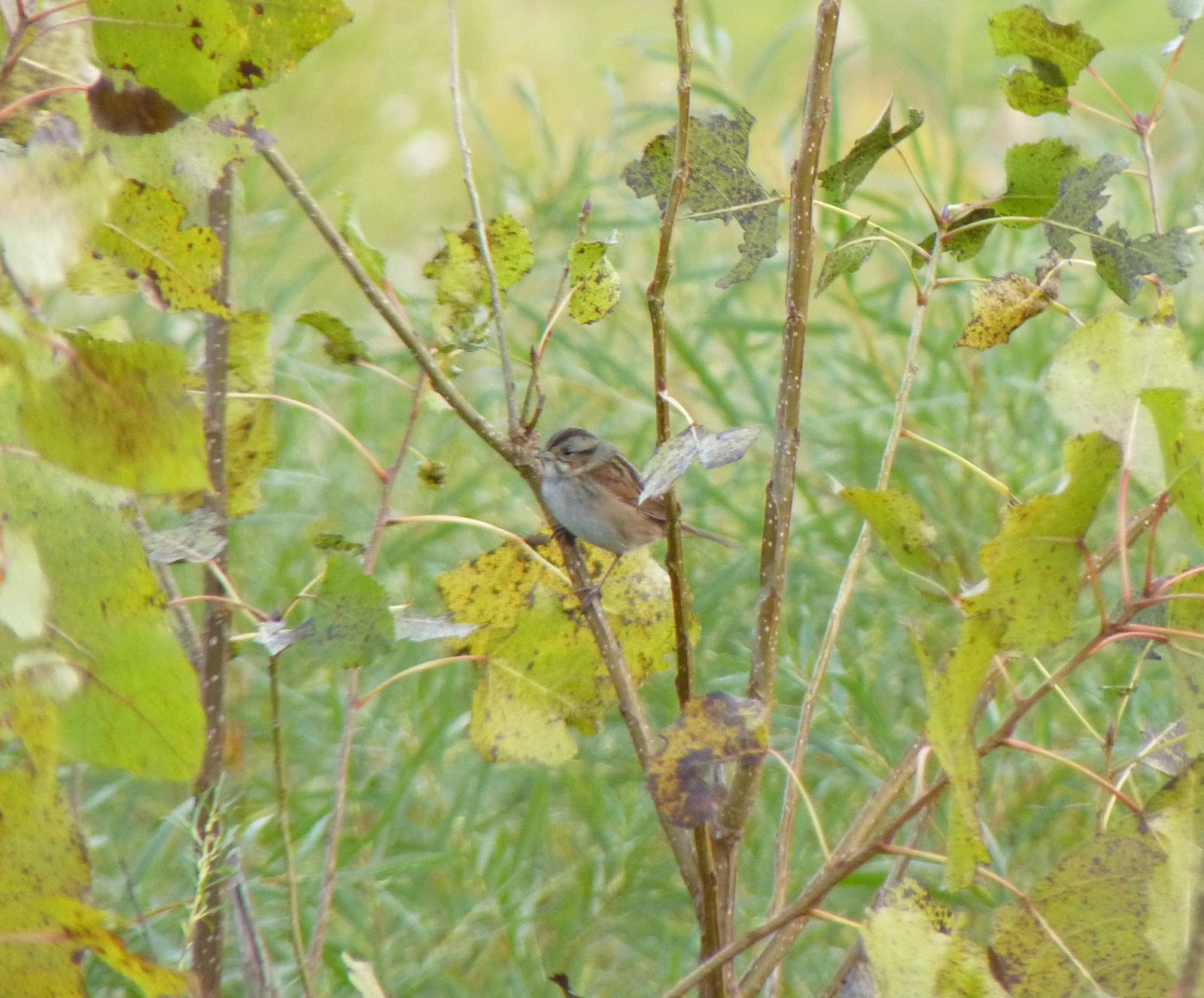
Swamp Sparrow


Savannah Sparrow


Lincoln's Sparrow


and some non-Sparrows...


Common Yellowthroat wishing it was a Connecticut Warbler


distant Northern Shovelers


Good birding and Bear down, Chicago.  BEAR DOWN!


Sell

September 21, 2010

Fall Migration Bird of the Day

I love fall  migration.  It goes on for so long as birds take their time, enjoying themselves on the way to their wintering grounds.  It is quite different from the mad dash these birds are on in spring to make it breeding grounds to set up territories and rear young.  Also, a lot of the weirder birds show up during the fall.  Chicago has already had Sandwich Tern and Black-throated Gray Warbler!  Michigan is proudly sporting a Magnificent Frigatebird (or Frigginbird) as of yesterday!  Crazy.  But in honor of fall migration, I have chosen one of the more dirt common birds.  His familiar "chip" will stick around later than most and for some in the South, he's a regular to the suet feeder.

The Yellow-rumped Warbler (Myrtle)


Also, as many people continue to tell me how much they hate fall because of the drab warblers, here is a fall warbler quiz.  I took shot this bird this morning around the neighborhood. 

Any takers?


Go eat some apples and drink some cider!

Sell.

September 1, 2010

Photo of the Day: American Goldfinch

A simple bird, yes, but one that holds onto it's bright plumage much later than other species.  This was taken at IBSP North Unit while looking for migrating shorebirds.


Sell

July 20, 2010

Photos of the Day

Hello intertubes:  I haven't been able to get out birding much recently, or if I have, it hasn't been anything really blogworthy.  So, to whet the appetites of my (numerous?) readers, here are a few pictures I've taken throughout the year of a favorite bird of mine:  The Red-headed Woodpecker


-Sell

July 11, 2010

When You Cut Them...they will come?

For some reason, I have time to write another small blog.  Just a few weeks ago, I was at 10,000 ft. enjoying the beautiful birds of the Colorado Front Range.  My aunt and uncle have a condo up there that, when you cross the road from their place, dumps you straight into Eagles Nest Wilderness Area.  Needless to say, I've become quite familiar with the bird life there over the years.

As a younger kid, I always loved crossing the street and immediately entering a pine forest.  It was place filled with the song of Swainson's Thrush, the "chuk-chuk-chuk" of Steller's Jays and the hoarse Black-capped call of Mountain Chickadees. Yet, when I showed up with my friends, bragging about how awesome my childhood trail was, I was nearly floored when I saw that they had clear cut nearly all of the beginning of the trail.  I couldn't even find the original trailhead.


These pictures don't even come close to doing it justice.  Especially how I remember it.  I was so upset.

 Apparently, the trees had to be cut down, as there was a massive beetle infestation taking over the pines that needed to be contained.  The dead trees were chopped down and as an earlier post shows, most were piled up in large stacks.

I understood it was necessary and many of the areas I loved to bird were still in tact.  It was just that the original "wow!" moment was lost; a piece of my childhood wonder taken from me.  To get to the areas I wanted to bird, I had to hike through this "wasteland."  And the first morning, I grumbled, head down, just trying to get to the creek and what I thought was better habitat.

Yet, as the days went by, I began to realize that the birdlife in this section was still pretty good.  In fact, this clear cut had created a new, open habitat that was supporting a lot of birds!  I even saw a life bird, a Sage Thrasher, in this burnt and cut down area!  It would be one of two life birds, so it was a real shocker, considering I have seen most birds you could see in the Colorado Rockies.  It was like God himself was reminding me that, where I might see destruction, the world sees opportunity for new life and I shouldn't complain, but explore and learn.

 Sage Thrasher at 10,000 feet?!

After my grumbling was over, I began to spend more time hiking off trail in this area.  I was pleasantly surprised!  First, because Aspen weren't infected by the beetles, there were a few stands left, where I found a Hairy Woodpecker.


They were guarding a nest, so I left ASAP...or should I say I was chased out.

I also heard many "Gray-headed" Dark-eyed Juncos, the soft downward tapping of Red-naped Sapsuckers and Dusky Flycatchers singing on the newly created edges.  But, the coolest was to come...


The second to last morning, I was out near dawn, exploring around the area, when I heard an unfamiliar call flying over.  I looked up just in time to see 4 Red Crossbills fly in and land on a long-dead pine snag.   I hurried over and even caught one singing!


Even when I was going to Colorado every year, this bird was always one of my favorites and one of the harder to find, so I was satisfied with that look.  On the way back to the condo through the clear cut area again, I heard the now familiar chirping coming not from overhead, but on the ground!


Suddenly, I realized that all around me were Red Crossbills!  I heard them flying overhead and singing in trees, and foraging on the ground.  I had never seen this behavior before.  I finally realized what was going on...

The felled trees had left a large pine cone crop on the ground and the crossbills saw it was easy pickin's.  I must have sat for an hour just watching them.  They were skittish, so I had to sit still, but when they got used to me, they didn't seem to mind my presence.


I learned my lesson.


Sell.

Photos of the Day: Henslow's Sparrow

Went out looking for shorebirds at Rollins Savanna.  Whiffed on them as there still aren't any open flats, but did find a good looking Henslow's Sparrow.  The Henslow's Sparrow is still an Illinois Endangered Species , but definitely growing in abundance thanks to growth in conservation.

These aren't DSLR quality, but I can't get over how well one can do with a Panasonic Lumix FZ-35 and a teleconverter lens.  This is from a good distance.
  For the money, it can't be beat!  Too many words...more photos.


Tis-lick!!!


Obviously not a Henslow's.....a juvenile Red-winged Blackbird.


Sell

July 7, 2010

Illinois Beach State Park North

In an effort to bolster my year list for Illinois, I went out to Illinois Beach State Park North.  As usual, I set my alarm for 4:30 AM, so I could get there around sunrise.  I awoke to the sun hitting my face, my phone across the room and the clock reading 7:00AM.


S*%&!!


The main reason I was bummed was because the temp today was in the high 80's with humidity near the same as the temp! 


 IBSP is one of the most unqique biospheres in N. Illinois.  It's dry habitat with scattered Black Oak on sandy ground has brought up a rare breeder for the second year in a row: Blue Grosbeak.  Though I could drive a few hours south and pick one up, there is something about seeing this bird on good habitat outside of it's normal range.  Also, this park has beautiful wild flowers.


Anyone know the ID on this flower?  Wild Rose?


The morning was sticky as all hell, yet this little road just can't seem to disappoint!


Got out of the car and was immediately greeted with the sound of two Yellow-breasted Chat's dueling it out on territories on either side of the road.  What a unique bird...


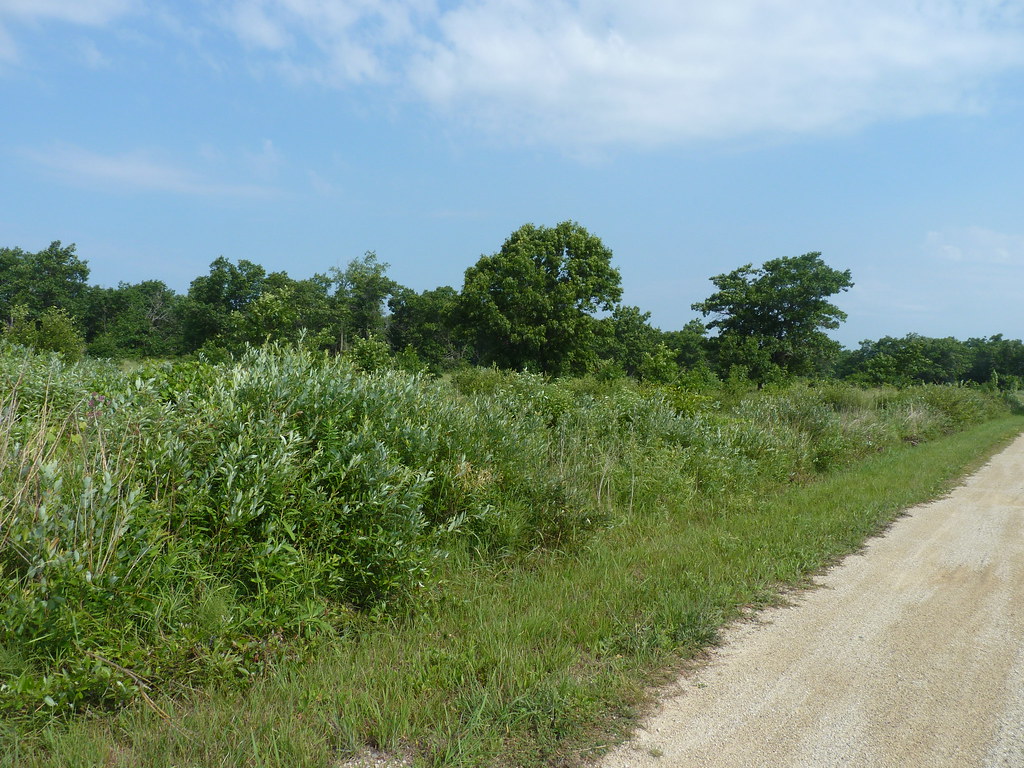
Perfect Chat habitat...no chat picture :(


Besides the chats, the bird song was pretty active.  There were gobs of Orchard Orioles, Warbling Vireos and Yellow Warblers.  Yet, the heat was opressive!  I love that the birds were singing through it.


The hunt was on for the grosbeak.  They are a medium sized bird, just bigger than their closest ID problem, the Indigo Bunting.  They also have longer tails and of course, a GROSbeak.  They have a soft, warbling song similar to a Painted Bunting (dont I wish...)


I was certain I'd see one, or at least hear it.  Today, the birding gods decided its been too long since I've worked hard for a bird to no avail.  I went up and down the road, sweated it out, got some sunburn, and pulled a big whiff on the bird.  Oh well.  I wouldn't be birding if I always showed and the bird was there.  A little frustration adds to the chase!  Besides, not seeing the grosbeak wasn't a total loss.  It was a good morning of birding!


First fake out!


Second Fake out!

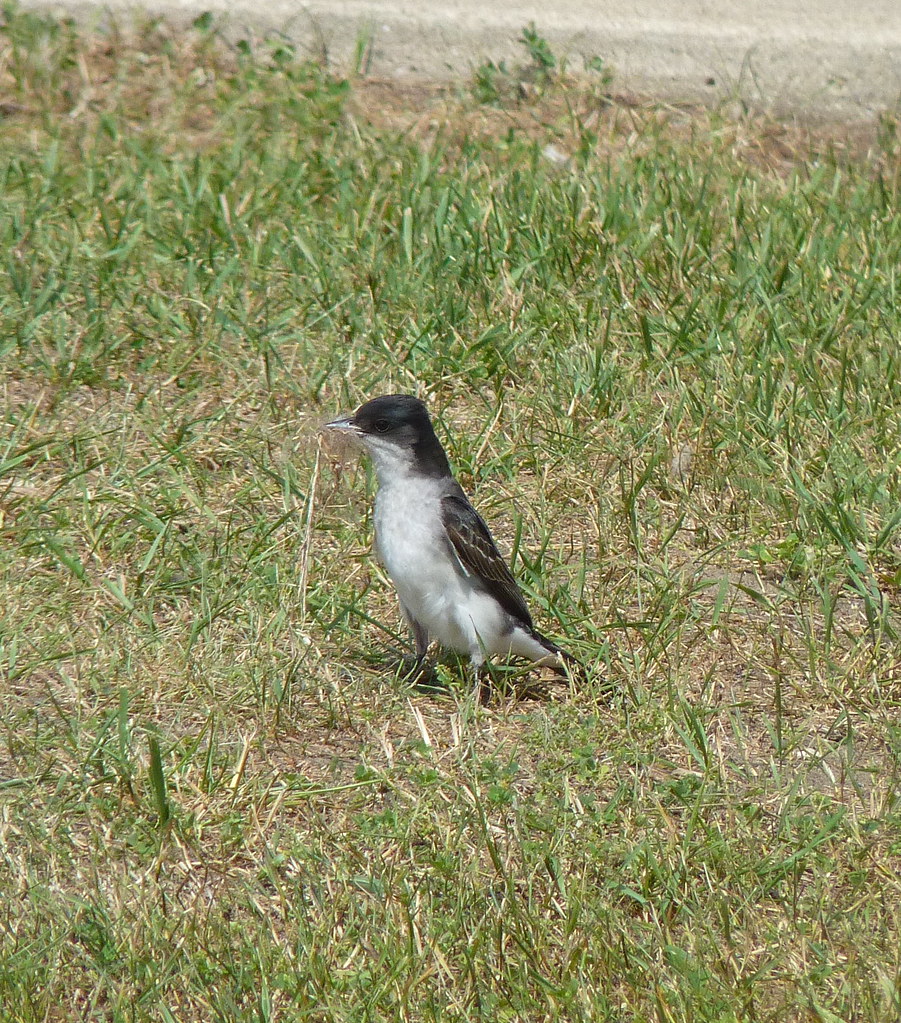
Eastern Kingbird with nesting material


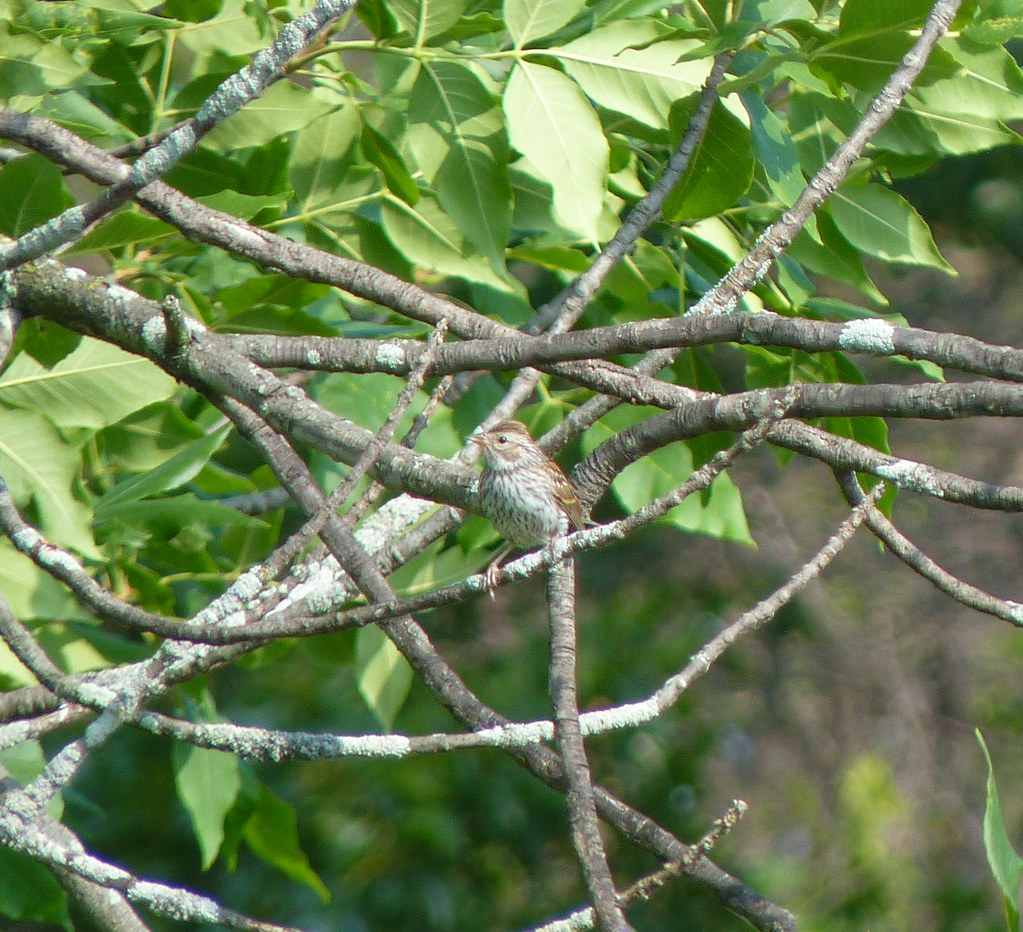
 Juvenile Sparrows in the Genus Spizella (Clay-colored, Chipping, etc.) look very similar to eachother.  I got a shot of one that is most likely a Chipping, but still can be a ID stump.   Staring at birds like this that can make you a better birder and give the occasional headache.


The road dead ends into the beach front, where I went left on an East-West road, sill looking fruitlessly for the Blue Grosbeak.  The lakefront had some thick humidity fog that was there to taunt me as I cursed my sticky Levis.


For my consolation, I was near shocked to hear two Sandhills calling relatively close.  I didn't see any young with them, unfortunately.


Video courtesy of Sir shakes-a-lot.


Please note the heat shimmer and fog :(


On the way back, feeling the bittersweet taste of a good birding day with out the target bird, I met up with one of my non-avian friends.


Later, I went almost to the Wisoncon/Illinois border, making a stop at North Point Marina and Spring Bluff Forest Preserve.  Always optimistic after Subway, I whiffed on my imaginary White-faced and Glossy Ibises, but was rewarded with great views of another pair of Sandhills, this time right next to the road.  Also, heard singing Swamp Sparrow and some "fitz-bew"ing Willow Flycatchers.


It was a good day birding despite the late start and the fact that I sweat enough to fill a reservoir.


Other birds of interest included:


Fly-by Black-billed Cuckoo


All the swallow species you can get here (Tree, Rough-winged, Bank, Barn and Cliff)


Singing Least Flycatcher at IBSP, which I'm hoping found a mate!


On one sad note...I saw this American Redstart, which is a hard-to-get Lake County breeding bird, feeding this "brood" along the road at IBSP.


Gah....


Sell.

June 25, 2010

Salt Lick Trail

Every morning, I've had the opportunity to bird right across the street from where I'm staying.  I just found out today that this trail is Salt Lick.  It's filled with childhood memories and great birding.

The trail has unfortunately been plagued, as has much of the front range, by a wood boring beetle that has killed most of the pine.  At the beginning of the trail, they just last year took down all the pine and left the timber in piles.


I thought this would be a huge problem, which is certainly is, but birds have adapted and in fact, some of the best birds of the trail were seen in this area.

The trail wind down from here to a beautiful creek that's filled with the sounds of Lincoln and White-crowned Sparrow, as well as Wilson's Warblers.


Wilson's Warbler Habitat


White-crowned Sparrow

Wilson's Warbler


Every where I went, I was followed by the high-pitched trill of Broad-tailed Hummingbirds.  I also had a   Rufous Hummingbird but couldn't get a shot of it. 


Broad-tailed Hummingbird


The trail continues West into some higher elevation and ultimately into a Wilderness Area that goes on forever.  I followed the river most mornings, and found a trail that went through some nice Aspen.


This area is filled with birds.  I found this guys near the edges.


And one of my favorites.

Red-naped Sapsucker

I'm off to cook some breakfast for the crew.  Eggs, sausage and steel-cut oats are sounding better than posting.  More to come.

Sell